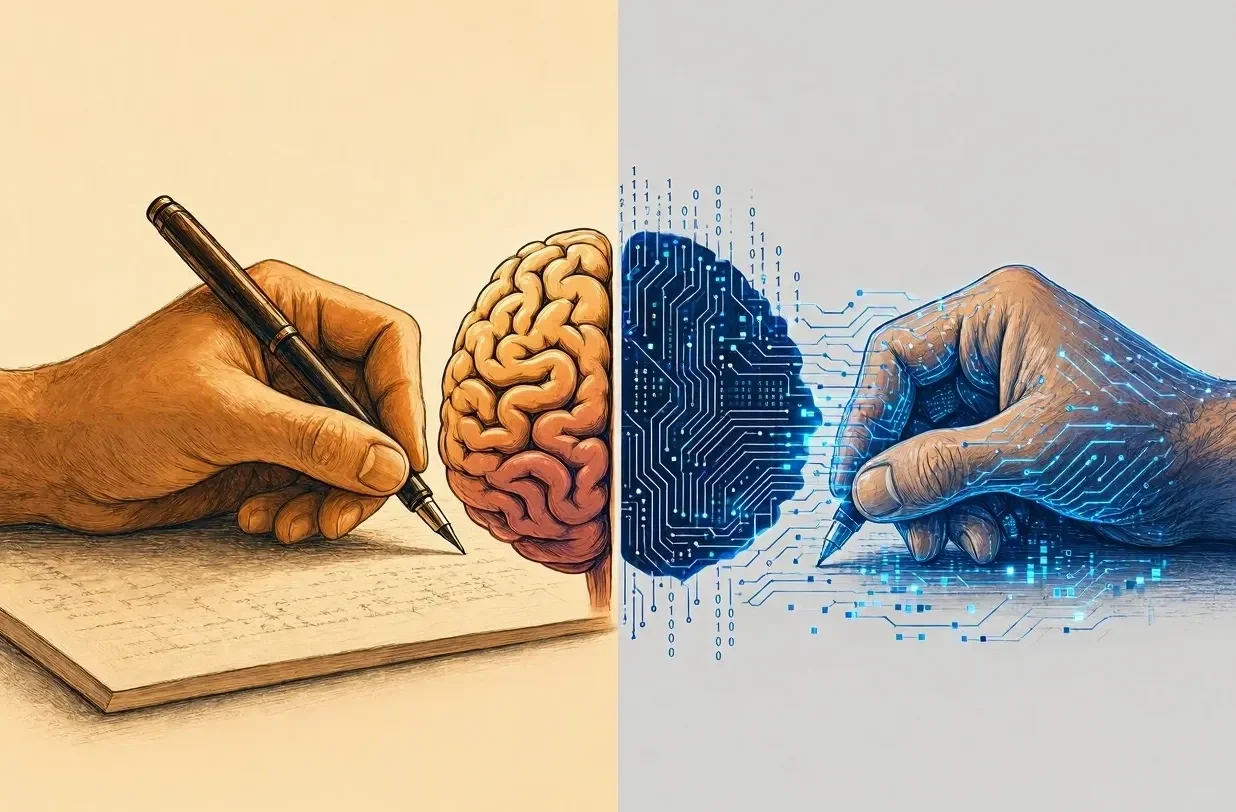
I used to lose entire afternoons in a bookstore, pulling a book off a shelf, reading the first page, and either getting pulled in or moving on to the next one. There was no rush. The research, the reading, the writing that came after — all of it took time, and that time was the point. It’s where the thinking actually happened.
That kind of time doesn’t feel like it exists anymore. Everyone’s jumping on the bandwagon of getting things done in the blink of an eye, and those of us who still lean toward slowness — toward sitting with a subject, getting fully immersed in it — are being left behind. Not just culturally, but almost structurally, like the world is adapting around a pace we no longer fit into.
And I think that’s the real threat. Not that AI exists, but that choosing not to lean on it is starting to look like falling behind, when really it might be the thing keeping us sharp.
This isn’t just a feeling I have. MIT’s Media Lab ran a study, memorably titled “Your Brain on ChatGPT,” where they had people write essays in three different ways: one group used ChatGPT, one used a search engine, and one group wrote entirely from their own heads, no tools at all. They tracked brain activity the whole time using EEG.
The results were stark. The brain-only group showed the strongest, most widespread neural connectivity of the three. The search engine group landed somewhere in the middle. The ChatGPT group showed the weakest connectivity by far — meaning the least cognitive engagement during the task. On top of that, when researchers asked the AI-assisted writers to recall what they’d just written, they struggled. They felt less ownership over their own essays. Less like the words were actually theirs.
That detail is the one that stays with me. Not that AI makes writing faster. We know that already. It’s that it can quietly erode your relationship to your own thoughts, to the point where you don’t even feel like the author of something you technically wrote.
That’s what I mean when I say becoming a creator is less about iterating fast and more about genuinely, deeply crafting something that isn’t already part of the norm. It’s a mental capability — the muscle required to sit with a hard idea, wrestle with it, and pull something original out of the struggle. And like any muscle, if you stop using it, it starts to atrophy.
I’m not interested in being dramatic about this. I’m not saying throw away your phone or swear off AI forever. I’m saying be honest about what you’re trading when you reach for the shortcut. Every time you ask a tool to summarize a book instead of reading it, or generate an argument instead of building one yourself, you’re handing over a small piece of the work that used to make you sharper. Do that enough times, across enough years, and you start to wonder how much of your own thinking you’ve outsourced without ever noticing.
I still wonder, the way I did as a kid. I still ask “what if” questions just to see where they lead. I still want to sit with a book and come out the other side having actually wrestled with it, not just absorbed a tidy summary of what it supposedly said. That’s not nostalgia. It’s maintenance. It’s me making sure that if every piece of technology in my pocket disappeared tomorrow, I’d still have everything I actually need — my own brain, my own words, my own ability to figure things out.
So here’s the choice, as I see it, because I don’t think there’s a universal right answer. You can lean fully into the convenience, let AI read for you, summarize for you, write for you, and save yourself the time and the mental effort. Or you can hold onto the harder path, the one where you still do the reading, still do the thinking, still sit with the discomfort of not knowing something until you’ve worked it out yourself.
Neither choice makes you a bad person. But only one of them keeps that muscle alive. And once it’s gone, I’m not sure convenience can give it back.